Monday, March 30, 2009
Venezia, Venezia, Scarpa, Scarpa (water, water)
This weekend my friend Lois and I went to Venice. Of course it was beautiful and I ended up finally taking a bunch of photos along with sketches. It was a nice break from Rome in terms of the architecture of the city. From the little bit that I picked up here and there, Venice really has no Roman Remains. It was mostly built up during Byzantine times and is affected greatly by Byzantine architecture. It was attempted at some point long ago to make Venice the new capital of the empire and thus much was looted from Constantinople and taken to Venice. The Moroccan pointed arch is very common in what you could call a Venetial Vernacular style and San Marco was filled with gold mosaics and had a feeling of solidity and massiveness that is not as apparent with flowery Baroque churches. Like every structure in Venice, San Marco had angled walls and puddles built up around the church hinting at the fact that it is sinking. Every tower we saw around the city was somewhat crooked. Classicism came later to Venice and it was almost commical to see some of the strict classical orders on buildings skewed and somewhat diagonal because of the non-uniform settling of the buildings. The whole city reminded me of the Titanic in some way and not really because both have and element of sinking involved (that's just a coincidence), but of the impending sense of disaster which is turned into a humorous spectacle. One of the nights we were there, Piazza San Marco flooded completely. We went out in rain boots and stomped around. People came out to see it as if it was a circus, but yet the very ground they were on was flooded and sinking. It reminded me of how even when the ship was close to completely under, the musicians played on and people sat to finish dinner.
It also seemed odd in the same sense, with the amount of beauty and ornateness put into the buildings whose very foundations were insecure. It would be like decorating a wedding cake with the highest quality, most expensive and best tasting frosting when the cake itself was a burned, boxed mix of Betty Crocker.
Sort of on the flip side, we saw a lot of work by the archtiect Carlo Scarpa.
see here for quick bio...
http://en.wikipedia.org/wiki/Carlo_Scarpa
He worked mostly from the 1930s-1970s. One work he did for the Fondazione Querini Stampalia, was a remodeling of an older building where he let the tidal waters come into the gallery. This way, the water was not a nusance but became a point of interest and a way for the building interior to constantly change. We unfortunately saw it at low tide but got some good pictures. I still don't know too much about scarpa but he seemed to pay a huge amount of attention to detail and material connections. Even when he did larger spaces or structures he worked across every scale from the total building, to the widow frames and door hinges. He did a few remodelings and exhibition layouts for the museums in Venice including the Accademia and the Ducale Palace but these museums don't really give him any mention. We began to spot a handful of places as we walked around Venice that were pretty much hidden or unmarked such as storefronts, houses and even a bridge that couldn't have been anyone but scarpa. He isn't really on the tourist maps. I'd bet 95% of tourists who have been to Venice still have never heard of him.
It was great to see his work and combined with the Byzantine influenced Venetian style was a nice change of pace from Rome.
It also seemed odd in the same sense, with the amount of beauty and ornateness put into the buildings whose very foundations were insecure. It would be like decorating a wedding cake with the highest quality, most expensive and best tasting frosting when the cake itself was a burned, boxed mix of Betty Crocker.
Sort of on the flip side, we saw a lot of work by the archtiect Carlo Scarpa.
see here for quick bio...
http://en.wikipedia.org/wiki/Carlo_Scarpa
He worked mostly from the 1930s-1970s. One work he did for the Fondazione Querini Stampalia, was a remodeling of an older building where he let the tidal waters come into the gallery. This way, the water was not a nusance but became a point of interest and a way for the building interior to constantly change. We unfortunately saw it at low tide but got some good pictures. I still don't know too much about scarpa but he seemed to pay a huge amount of attention to detail and material connections. Even when he did larger spaces or structures he worked across every scale from the total building, to the widow frames and door hinges. He did a few remodelings and exhibition layouts for the museums in Venice including the Accademia and the Ducale Palace but these museums don't really give him any mention. We began to spot a handful of places as we walked around Venice that were pretty much hidden or unmarked such as storefronts, houses and even a bridge that couldn't have been anyone but scarpa. He isn't really on the tourist maps. I'd bet 95% of tourists who have been to Venice still have never heard of him.
It was great to see his work and combined with the Byzantine influenced Venetian style was a nice change of pace from Rome.
Sunday, March 22, 2009
a little ride on my Bici


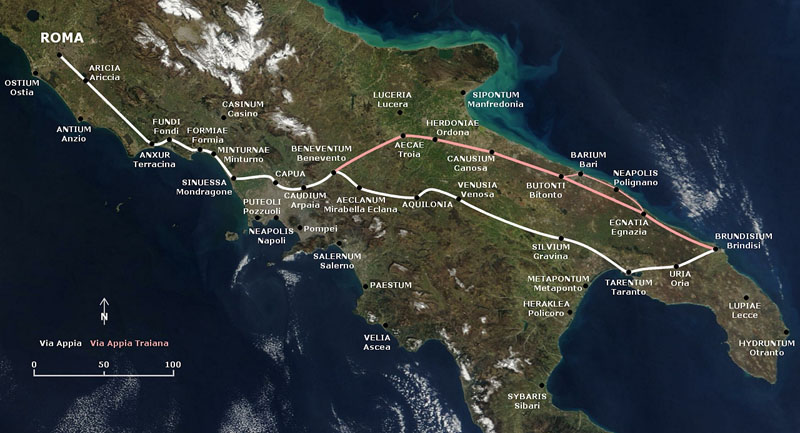
Today I went for a nice long ride on the Via Appia Antica on one of the communal Cenci bikes. The Appia Antica or Appian Way was the most important of ancient Roman roads (It came up a lot in my old days of latin class). It is now no longer a road that cars really go on but a pedestrian jogging/biking trail. There were a lot of Italians out enjoying it and only a handful of tourists which was refreshing. I even saw what looked like a mini fashion photo shoot and a bride and groom taking wedding photos. I met an older Italian couple while looking at some ruins who were very kind and thought that I was German and when I responded "sono americano" there were even a little bit surprised (this made me feel really good!). I biked a long ways and saw my first aqueduct, a lot of sheep with a grumpy old shepherd, a few tombs and lots of unidentifiable ruins and piles of ancient brick. In some places the ancient paving stones are still exactly as they were in Roman times and although very incredible, really hard to bike on. You can see ruts where chariots wore down the stones. It remained sunny for the whole day. On my way home I stopped near a field and came upon a tiny chapel that was really very beautiful. It was a very simple, classical brick structure with five small windows. The space for some reason made me think of Eero Saarinen's MIT chapel. Small, brick with very limited and controlled natural lighting.
Tuesday, March 17, 2009
I can't help but be a bit of a romantic...
As the days get longer and the weather feels more like a New England early summer, it is hard to avoid errands turning into long strolls, sketching adventures lasting into evening and afternoon coffee runs turning into sit down affairs. Rome has not mellowed or exhausted my intoxicating fascination of Calvino one bit and sitting on the steps up to the Capitoline hill at dusk with a copy of Difficult Loves or If on a Winter's Night a Traveler has become a habit (Next to come is a re-read of Invisible Cities). I just realized that Calvino passed away in Siena where I was just a couple of weekends ago.
Under the cover of darkness I've been working strictly in studio on a few different projects, drafting a lot and painting. One evolving exercise that I try to spend a few minutes a day on is to take things that I've sketched and draft them out in axon based on only my loose sketches. I have to think about how the space is represented gesturally, emotively and in a seemingly architectural way and how it translates between the different methods of drawing. Each type of drawing has a different kind of accuracy. I've been adding parts together and the result is a conglomerate that is turning into a Calvi
noesque dream city.
Calvino isn't strictly the only thing I'm reading and I should mention, Delirious New York. I was a little hesitant to bring it with me, but reading about the growth and origins of New York is helping me understand a lot about Rome because it is so different. It's like having two opposties; the contrast you realize helps you understand the most about both.
Despite the perceived increasing relaxation, I've still been producing a lot, lot and have caught myself still walking a lot faster than most Italians.
Under the cover of darkness I've been working strictly in studio on a few different projects, drafting a lot and painting. One evolving exercise that I try to spend a few minutes a day on is to take things that I've sketched and draft them out in axon based on only my loose sketches. I have to think about how the space is represented gesturally, emotively and in a seemingly architectural way and how it translates between the different methods of drawing. Each type of drawing has a different kind of accuracy. I've been adding parts together and the result is a conglomerate that is turning into a Calvi
noesque dream city. Calvino isn't strictly the only thing I'm reading and I should mention, Delirious New York. I was a little hesitant to bring it with me, but reading about the growth and origins of New York is helping me understand a lot about Rome because it is so different. It's like having two opposties; the contrast you realize helps you understand the most about both.
Despite the perceived increasing relaxation, I've still been producing a lot, lot and have caught myself still walking a lot faster than most Italians.
Friday, March 13, 2009
This is unrelated to Rome but I've decided to post other things that are interesting...partly so I can have a record of them. I hope to see this when I try and go to Berlin for part of spring break. From the NYTimes photos it looks pretty incredible.
http://www.nytimes.com/2009/03/12/arts/design/12abroad.html?ref=design
For Berlin Museum, a Modern Makeover That Doesn’t Deny the Wounds of War
Forum Time
We've been here just under 2 months but I just got to the Forum today. For 9 Euro you get one ticket which you can use at the Colosseo, Palatine Hill, and Forum over two days. I thought I could at least see the Forum and maybe the Colosseum today but after sketching all day at the Forum I got kicked out at close without even seeing it all. I'll post some of the sketches later.
It is really interesting to try and visualize what the forum was like. If you stand there and try it, you'll come up with some conglomerate, hybrid mini-city because what exists today are parts of structures from many different time periods. The problem with the archaeological excavations at the forum (and elsewhere) is that there is so much from so many different eras. And it is not layers that are formed, but one infusion that can only be chipped apart and not pulled apart. In short, the ruins aren't stacked, but melted together. To get to some of the "exciting stuff" they have to remove what is above which is also pretty ancient. At the beginning of our time here I remember our art history teacher, Ezio, talking about how when ruins are discovered, the archaeologists have to essentially decide where to cut the site and stop digging. There will always be more below and always something above that has to go.
Tomorrow I plan on seeing the Palatine Hill and Colosseo. I'll have to go faster this time. At least there's about a 100% chance that I'll go a few more times this semester.
It is really interesting to try and visualize what the forum was like. If you stand there and try it, you'll come up with some conglomerate, hybrid mini-city because what exists today are parts of structures from many different time periods. The problem with the archaeological excavations at the forum (and elsewhere) is that there is so much from so many different eras. And it is not layers that are formed, but one infusion that can only be chipped apart and not pulled apart. In short, the ruins aren't stacked, but melted together. To get to some of the "exciting stuff" they have to remove what is above which is also pretty ancient. At the beginning of our time here I remember our art history teacher, Ezio, talking about how when ruins are discovered, the archaeologists have to essentially decide where to cut the site and stop digging. There will always be more below and always something above that has to go.
Tomorrow I plan on seeing the Palatine Hill and Colosseo. I'll have to go faster this time. At least there's about a 100% chance that I'll go a few more times this semester.
Sunday, March 8, 2009
la primavera?
Today was the first day I noticed the ubiquitous umbrella salesman have started to sell little yellow flowers. At least instead of umbrellas in my face now every time I stand to look at the Trevi, Pantheon or Spanish Steps there will be flowers.


Here are some images from the last two days in Siena. The image on the yellow paper is the only one that is not Siena and is from the Pamphilj Gallery in Rome where there are two early Caravaggios. The Duomo in Siena is amazing. Similar to the one in Florence but a little smaller. The white marble was striped occasionally with a black stone and it was higly ornate but not in a baroque like way (there was very little gold). It is a more embellished classical style with a tiny injection of gothic. The floor was completely inlaid marble with patterns and scenes I could barely begin to draw. The two interior sketches are from the Duomo. The watercolor is from next to the Duomo where in the 1300s (i think) an extension was begun but never finished due to a lack of funds and the plague. What was built of that eventually got infilled with other buildings. It was an interesting space. What was supposed to be the inside of the cathedral addition is now a courtyard like space, and what was going to be the outside is now a hodgepodge of other buildings. All the rest of the sketches are from the large main piazza, Piazza del Campo. It is shaped like a giant half shell and acts sort of like and ampitheater. People sit aroud on it all day and move with the sun. The giant bell tower on one of the buildings is like an enormous sundial.
I had a cappuccino out there one morning and even though it is still a little chilly, the sun is intensly hot. It gives me a new understanding of Camus's The Stranger.
Thursday, March 5, 2009
Wednesday, March 4, 2009


Here are some more. I got a larger pad of paper about 18x14 or so inches and the darker building was the first sketch I did on that from about a month ago. There is a little park a block away from us on a main road called Via Arenula and this is from that park.
The other drawing is of some ruins a few blocks from us in the other direction. I think it is my new favorite place to draw in the late afternoon!
Monday, March 2, 2009

Today was rainy and lazy. We had an alumni of risd and ehp come in and do a fresco painting demonstration. She has been living outside the US ever since she graduated from risd.
Fresco painting is when paint is applied to semi-wet plaster and then as the plaster and paint dry they become one. This is why frescoes from as far back as the roman era are still preserved. If paint was applied to simply a dry plaster wall there is a much larger chance that it would flake off.
Above is a fresco I saw a few weeks ago in Arezzo.
Also today, I started drawing on small plywood panels with pen and really like it. We'll see where it goes...
Subscribe to:
Comments (Atom)